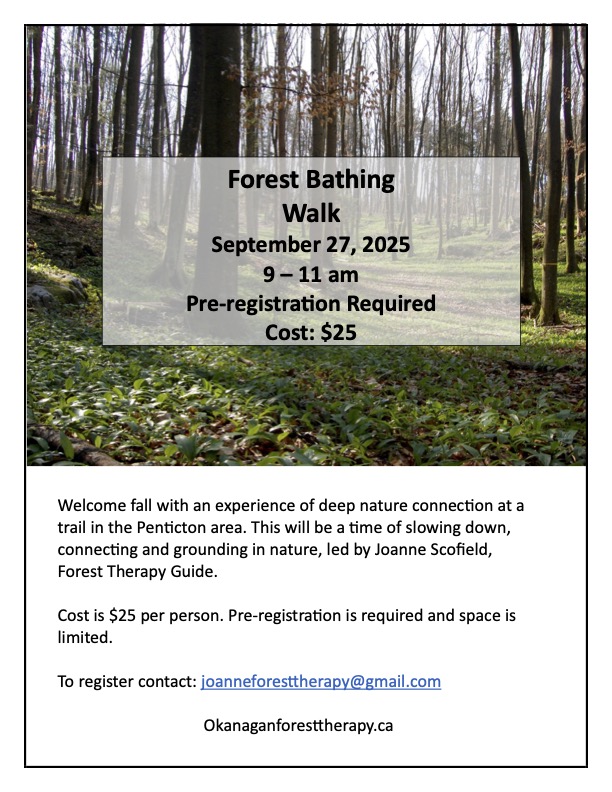
Forest Bathing Walk, Welcoming Fall, Sept 27, 2025

I’m excited to announce a Forest Bathing retreat, September 6 – 8 at Sorrento Centre. Join me in this beautiful setting for time to relax, re-charge and nurture your soul.
More information and to sign up, can be found on Sorrento Centre’s website. Click here.
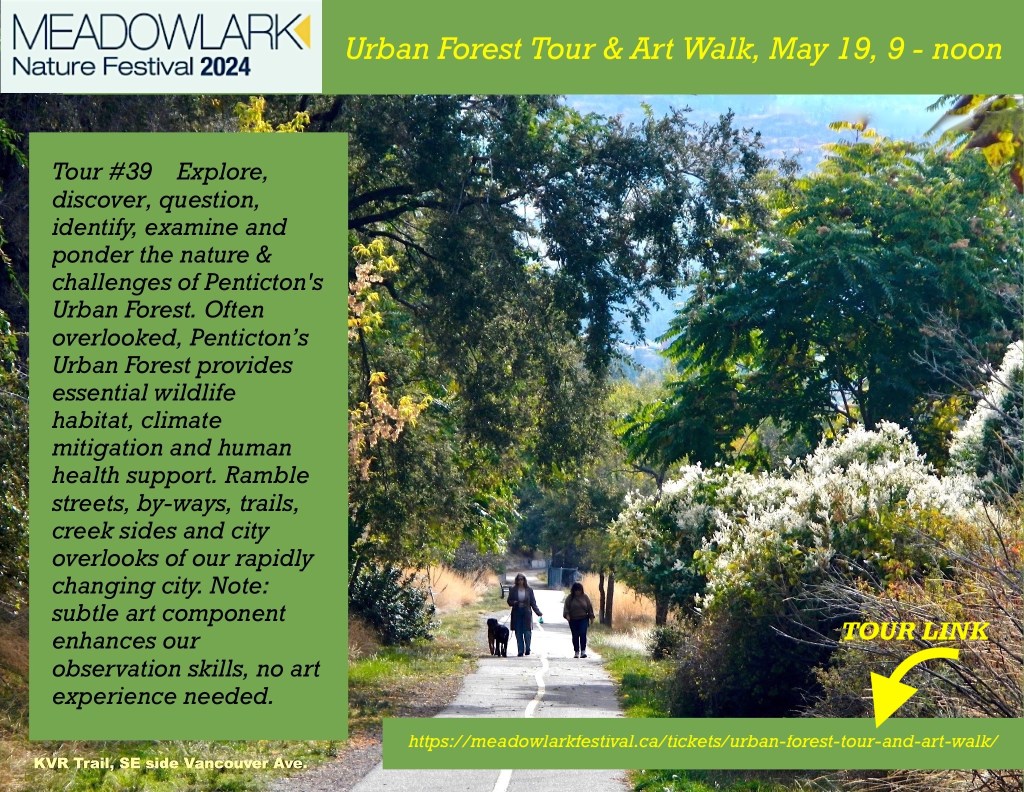
The May long weekend is the Meadowlark Nature Festival. It is a fantastic festival of activities that explore and celebrate the natural environment of the Okanagan Similkameen.
I will be part of the leadership for the Urban Forest Walk this weekend! Come, join us, it will be fun!
Urban Forest Tour and Art Walk, Tour #39 Meadowlark Nature Festival. Explore, discover, question, identify, examine and ponder the nature and challenges of Penticton’s Urban Forest…the planned and unplanned Green Infrastructure of our city environment. Often overlooked, Penticton’s Urban Forest provides essential wildlife habitat, climate mitigation and human health support. With biologist Lia McKinnon (tree interpretation); Forest Bathing facilitator, Joanne Scofield (short sensory tune-up), and; Penticton Trees FB advocacy group founder, artist, Nature Wise columnist Dianne Bersea…we’ll ramble streets, by-ways, trails, creek sides and city overlooks of our rapidly changing city. Join us to experience some of the best and not so successful elements of Penticton’s natural environment. Note: this event includes subtle art component to enhance our observation skills, but absolutely no art experience required.
Happy first day of spring! Today is March equinox, or vernal equinox. It marks the first day of spring in the Northern Hemisphere. It is the day when the Northern and Southern Hemispheres receive roughly equal amounts of sunlight.
Spring is a time when new life begins to emerge after a time of dormancy and rest during winter. You’ve likely noticed the amount of sunlight increasing since winter solstice in December. It begins slowly, then speeds up noticeably in early February, and will continue to increase until summer solstice in June. Trees are beginning to bud and early spring bulbs are poking through and in some places blooming. Here in the Okanagan, buttercups have bloomed, a sure sign of spring. Birds are returning and we can hear the call of their song. The sun feels warmer on our skin.
This can feel like an optimistic time as life stirs and colour begins to pop. Many cultural and faith traditions celebrate the newness and hope that we experience at this time. And many of us get back to spending time outside – in the garden, walking, hiking, sitting in the sun.
An invitation
Being curious about the natural rhythms of nature and noticing parallels to your own life can be a way of discovering new things about nature, yourself, and others. It can also bring you into deeper connection with the natural world. When you are out walking or sitting in nature, for some that might be at their sit spot, take some time to connect to your senses and be curious about what draws you.
Notice colours that draw your attention or new life emerging. It might be the colour of a red bud, or yellow flower. How is the light changing as the sun’s position moves?
Close your eyes and notice the sounds that you hear. Is that a new bird calling?
Notice what you can smell as spring arrives.
Notice how the ground feels as it begins to warm up?
Allow yourself to enjoy these sights, sounds, scents and touch.
Deeper reflection: You may also want to reflect and perhaps journal about how what you are seeing mirrors what’s happening your life. After a time of winter and dormancy, what new idea or calling is beginning to emerge in your life? Where are you being drawn? What can you leave behind to make room for this newness? Where are you seeing hope in your life.
I was recently invited to write a reflection for the Pacific Jubilee blog. Here is an excerpt from my reflection that is now posted on their site…
I arrive at the lake for a morning walk with my dogs. I am a bit late this morning so when I get out of my car, I notice construction has already started at a building site in the distance. I put my earbuds in, the voices from a favourite podcast drowning out the sound of construction vehicles.
As I start walking, I notice snow starting to fall. I’m not really a winter person so I pick up my pace hoping I won’t get caught in a storm. As I walk, the lightly falling snowflakes catch my attention. I feel drawn to stop and watch. Each flake in a dance with another flake, slowly falling, as if moving and being suspended in air at one time.
To read the full text, check out Pacific Jubilee website by clicking here.
From the Jubilee website: Jubilee is a Canadian offering of experiences in spiritual growth, soul development and the art of spiritual direction.
I’m excited to announce a Forest Bathing retreat, planned for September 8 – 10 at Sorrento Centre. Join me in this beautiful setting for time to relax, re-charge and nurture your soul.
More information and to sign up, can be found on Sorrento Centre’s website. Click here.
This post appeared as an article in the South Okanagan Naturalists’ Club newsletter, The Honker, March 2022. It has been edited for this space.
If you are someone who enjoys being in nature, you can probably name many benefits from spending time outside. Sometimes you might feel a boost of energy after a brisk walk, or you may notice that you’re happier, or feel better when you come in from being in the garden. Maybe you notice a deeper sense of peace after a walk in the woods.
Research has shown what we intuitively know, that nature has many healing qualities. While research is continuing to develop and more is always needed, preliminary studies strongly indicate that the health benefits of being outside in nature include: boosted immunity, reduced blood pressure, increased heart rate variability, mood stability and reduce impacts of Attention Deficit Disorder. These benefits come from different aspects of the natural world. For example, when we slow down and connect to our senses while we are in nature, our parasympathetic nervous system is activated, which can slow down our stress reactions, bringing us into a state where healing can occur. Naturally occurring chemicals from trees, called phytoncides, have been shown to act as a de-stressor, reducing cortisol levels and bringing us to a more relaxed state. They have also been shown to increase a type of white blood cell called NK cells, natural killer cells, and this can help boost immunity levels (Li et. Al 2009). Gentle, natural sounds from the forest can also help to lower blood pressure and increase heart-rate activity (Miyazaki 2018). While experiencing these elements individually is good, the greatest benefit occurs when the natural landscape is experienced as one. Studies suggests that the minimum time being outside for health benefits is 120 minutes, with increased benefits at three hours (White et. Al. 2019).
The experience of finding healing in the natural world has been part of many cultures and regions of the world for a long time. Recently, there has been a global movement of forest therapy, or forest bathing, inspired by shinrin-yoku, a Japanese practice of connecting with nature through all of our senses. Health bodies around the world have also begun to embrace the potential health benefits of being in nature with green prescription programs in countries such as New Zealand, Ireland and England and the United States. In November 2020, B.C. Parks Foundation started Canada’s first national nature prescription program. In January 2022, Parks Canada signed on to the initiative. Now, health-care professionals can offer patients a Parks Canada Discovery Pass — free of charge.
The next time you are out in nature, take some time to intentionally slow down, connect to your senses and experience the gift of deep nature connection.
If you’d like to learn more, here are some suggestions for further reading:
Forest Bathing: How Trees Can Help You Find Health and Happiness book by Quing Li
Nature Prescriptions: https://www.parkprescriptions.ca
Global Institute of Forest Therapy: https://www.giftoftheforest.com
Effects of Forest bathing trips on human immune function, Quing Li, Environmental Health and Preventative Medicine https://www.ncbi.nlm.nih.gov/pmc/articles/PMC2793341/

 Okanagan Forest Therapy